.svg)

Understanding On-Page SEO Score: What It Is and How It's Calculated | Optilinko
In the world of SEO, one of the most important aspects to focus on is on-page optimization. By increasing the chances of improving your web pages effectively, you increase their chances of ranking higher in search engine results. But how do you know whether a page is well-optimized? This is where the On-Page SEO Score comes into play. Let’s break down what it is, how it’s calculated, and why it’s important for your SEO strategy.
What is an On-Page SEO Score?
The On-Page SEO Score, or simply onpage_score, is a proprietary metric used to measure the quality of technical page optimization. This score is provided by OnPage API, and it helps webmasters and SEO specialists gauge how well a specific page is optimized for search engines.
This score ranges from 0 to 100, with 100 being the best possible score, indicating that the page is fully optimized with no critical errors or warnings. A score of 0, on the other hand, signifies that the page has many optimization issues and is not performing well from an SEO perspective.
In short, on-page_score helps you understand how effectively a web page follows on-page SEO best practices. It's based on key factors like page loading time, title tags, duplicate content, image alt texts, and more.
Where Can You Find the On-Page SEO Score in Optilinko?
Optilinko provides the on-page score through various endpoints. These endpoints allow you to track the score for individual pages, domains, and various resources. Here are the main endpoints where you can find the on-page score:
These endpoints allow you to track how individual pages are performing in terms of on-page SEO and can help you identify areas for improvement.
How is the on-page SEO Score Calculated?
The on-page score is calculated based on the presence of critical errors and warnings on a page. Each issue has a specific weight assigned to it, and these weights are used in the formula to calculate the score. Here's how the calculation works:
The Formula
The score is calculated using the following formula:
Sc = 100 – ∑(En/78) x 55 – ∑(Wn/123) x 45
Where:
-
Sc = On-Page score of a page.
-
En = The value of an error the page has.
-
Wn = The value of a warning the page has.
-
78 = The total value of all errors taken into account.
-
123 = The total value of all warnings taken into account.
-
55 = The maximum On-Page score for the Errors category.
-
45 = The maximum On-Page score for the Warnings category.
The calculation works by subtracting the scores of both errors and warnings from the maximum possible score of 100.
Example Calculation
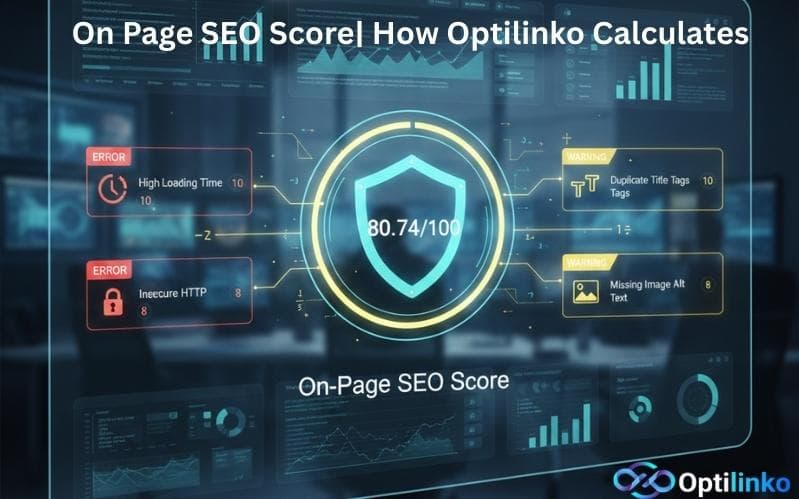
Let’s consider a page with the following issues:
Errors:
-
High loading time: Score = 10
-
Insecure HTTP protocol (is_http): Score = 8
Warnings:
-
Duplicate title tags: Score = 10
-
Missing image alt text (no_image_alt): Score = 8
Here’s how the score would be calculated:
Step 1: Calculate the score for each check:
Errors:
-
High loading time: (10/78) x 55 = 7.05
-
Insecure HTTP: (8/78) x 55 = 5.64
Warnings:
-
Duplicate title: (10/123) x 45 = 3.65
-
Missing image alt text: (8/123) x 45 = 2.92
Step 2: Add up the check scores:
-
Total errors score: 7.05 + 5.64 = 12.69
-
Total warnings score: 3.65 + 2.92 = 6.57
Step 3: Subtract the total error and warning scores from the maximum possible score (100):
On-Page Score = 100 – 12.69 – 6.57 = 80.74
So, the onpage_score for this page would be 80.74.
Critical Errors and Warnings
The onpage_score is determined by two key categories of issues:
1. Critical Errors
Critical errors have a higher impact on the page’s SEO, and each one is assigned a value. Here are some common critical errors:
-
High loading time: If a page takes longer than 3 seconds to load, it can significantly hurt your ranking. Value: 10
-
Redirect loop: When a page redirects to another, which then turns back to the original page, causing an infinite loop. Value: 10
-
Duplicate content: When a page has content that appears on other pages. Value: 4
-
Broken links: If the page contains links that lead to non-existent or error pages. Value: 5
These errors should be addressed immediately as they directly impact the user experience and search engine rankings.
2. Warnings
Warnings are not as intense as errors, but they still affect a page’s optimization. Here are a few common warnings:
-
Duplicate title tags: If a page has multiple title tags, it can confuse search engines. Value: 10
-
Missing alt text for images: If images don’t have alt attributes, it impacts accessibility and SEO. Value: 8
-
Large page size: If a page is too large (over 256KB), it may load slowly. Value: 10
-
No H1 tag: An H1 tag is essential for SEO as it indicates the main topic of the page. Value: 5
While warnings are less critical than errors, fixing them can improve the overall optimization of the page.
How to Improve Your On-Page SEO Score
Improving your on-page score is a crucial part of SEO. Here are a few ways to do it:
-
Optimize Page Speed: Ensure that your pages load quickly. Compress images, use browser caching, and minimize JavaScript.
-
Fix Broken Links: Regularly inspect for broken links and replace or remove them.
-
Use Secure HTTP (HTTPS): Ensure your site uses a secure HTTPS protocol, as Google considers this a ranking factor.
-
Optimize Title and Meta Tags: Ensure your page titles are unique and descriptive. Avoid duplicate titles across pages.
-
Add Alt Text to Images: Include explanatory alt text for all images to boost accessibility and SEO.
Conclusion
The onpage_score is a useful metric for any SEO expert looking to optimize their website. By understanding how it’s calculated and what factors impact it, you can take proactive steps to enhance your page’s performance. Keep an eye on critical errors and warnings, fix them promptly, and your site will become more search engine-friendly, leading to higher rankings and better user engagement.
If you haven’t already, start using tools like OnPage API to track your on-page SEO score and make data-driven decisions to optimize your site effectively. And with Optilinko’s various endpoints, you can get detailed insights into your pages’ performance and improve your SEO strategy.
FAQs
It’s a metric that measures how well a webpage is optimized for search engines, considering factors like keywords and content quality.
It improves your webpage’s search engine ranking and visibility, driving more organic traffic.
It’s calculated by evaluating on-page factors like keyword usage, content, internal links, and page speed.
Factors include keyword optimization, content quality, internal linking, page speed, and mobile-friendliness.
Use targeted keywords, optimize titles and meta tags, improve content, and ensure fast load times.
No, Off-Page SEO, like backlinks, is also important for rankings.
Check it regularly, especially after content updates or site changes.