.svg)

Keyword Difficulty in SEO - Definition, Importance & How to Check It for Better Rankings | Optilinko
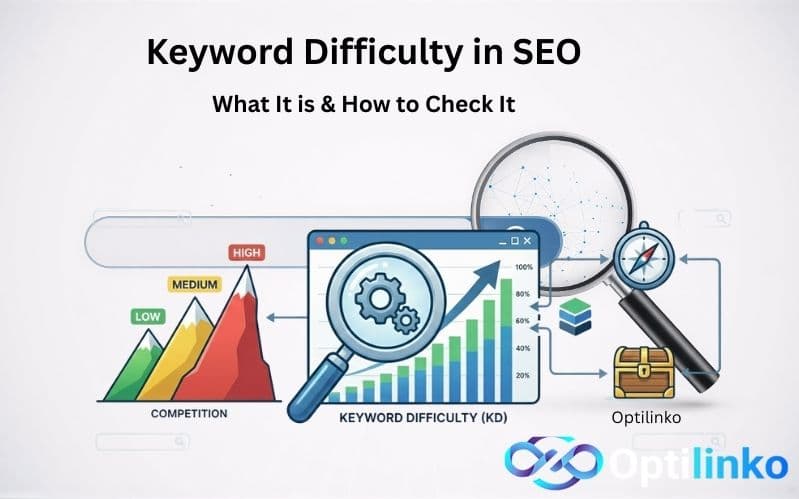
In the competitive landscape of SEO, understanding keyword difficulty (KD) is essential for effective content strategy and optimization. This blog post dives deep into what keyword difficulty is, why it matters, how it's measured, and how to effectively evaluate it using various methods, including the features offered by Optilinko.
What Is Keyword Difficulty?
Keyword difficulty refers to the level of competition associated with a particular keyword or phrase in search engine results. Essentially, it quantifies how challenging it would be to rank in the top search results for that keyword.
Why It Exists
Keyword difficulty exists because search engines, such as Google, prioritize content relevance and quality. With millions of pages competing for the same keywords, not every piece of content can rank high. This competition leads to varying degrees of difficulty across different keywords.
How Search Competition Impacts KD
As more websites target a particular keyword, the difficulty increases. Search competition impacts KD based on several factors, including the number of pages competing for that keyword and the authority of those pages. High competition usually indicates that many reputable sources are already ranking well, thus raising the difficulty level.
Low vs. Medium vs. High Keyword Difficulty
Low Keyword Difficulty: Keywords that are relatively less competitive. They are great targets for new or smaller websites aiming to establish their presence.
Medium Keyword Difficulty: These keywords generally have moderate competition, making them suitable targets for websites with some authority and content history looking to grow.
High Keyword Difficulty: Highly competitive keywords are typically dominated by established websites. Targeting these requires a stronger domain authority and extensive content strategies.
Why Keyword Difficulty Matters
Understanding keyword difficulty is crucial for several reasons:
Helps Content Planning
By assessing the difficulty of keywords, marketers can better plan their content strategy, targeting keywords that align with their current or desired authority and market position.
Helps Identify Realistic Keywords
Knowing the KD of a keyword helps identify which terms are realistically achievable for your website based on its authority and existing content.
Helps Avoid Wasting Resources
Focusing on highly competitive keywords can drain time and resources with minimal returns. Understanding KD allows teams to strategize more efficiently.
Boosts Ranking Potential
Targeting the right keywords—those with suitable difficulty levels—improves prospects of ranking higher in search results and attracting relevant traffic to your site.
What Is a Keyword Difficulty Score?
KD Metrics
Keyword difficulty scores are typically provided as a percentage or on a scale (e.g., 1-100), with higher scores indicating greater competition.
How KD Is Calculated
KD calculations are usually based on an aggregation of various factors that represent the competitive landscape for that keyword.
Factors Affecting KD
1. Domain Authority: Established websites with high domain authority typically rank for difficult keywords, thus raising the keyword difficulty score.
2. Backlinks: The number and quality of backlinks pointing to the top-ranking pages influence how difficult it might be for other sites to rank for the same keyword.
3. Page Quality: Content relevance, user experience, and how well it satisfies search intent also play a critical role in determining difficulty.
4. SERP Competition: A quick evaluation of the current SERP (Search Engine Results Page) can reveal how many competitors are actively ranking for a specific keyword.
How to Check Keyword Difficulty
Manual Method
1. Reviewing SERPs: Sometimes, a glance at the first page of a Google search can provide insights into keyword difficulty. Assess the list of domains and content types and note their apparent authority.
2. Checking Backlinks of Ranking Pages: Tools like Ahrefs or Moz allow you to see the backlink profiles of the top-ranking pages, giving context to their authority.
3. Checking Domain Authority: Use tools that evaluate the domain authority of the competing sites listed in SERPs to better understand the competitive landscape.
4. Understanding Content Intent: Analyze the type of content that ranks for the keyword. Is it a blog post, a video, or a product page? Understanding intent helps shape your content strategies.
Using Keyword Difficulty Tools
-
Ahrefs KD: A robust tool that provides a difficulty score along with comprehensive backlink analysis.
-
Semrush KD: Offers a user-friendly interface to evaluate keyword difficulty while providing competitive insights.
-
Moz Keyword Difficulty: Highlights the competitiveness of keywords with a reliable scoring system.
-
Free Alternatives: Consider Google Keyword Planner or Ubersuggest for basic KD insights.
-
Limitations of KD Tools: Remember that while tools provide estimates, they should not be your only reference point due to varying sophistication across platforms.
How Optilinko Helps with Keyword Decisions
Optilinko offers valuable insights that can support your keyword research strategy by indirectly assessing difficulty through competitor analysis and performance metrics.
1. Ranked Keywords Tool

This tool shows the real ranking keywords for your domain, helping discover low-competition opportunities in your niche.
2. Competitor Backlink Gap Analysis
Optilinko’s analysis allows you to understand why certain keywords rank well for competitors and quantify competitor authority for nuanced insights, aiding in indirect judgment of difficulty.
3. SERP Competitors Overview

This feature helps assess real search competition by providing a comprehensive look at the types of content that currently rank, further informing your strategy.
4. Backlink Strength Indicators
These indicators allow for an indirect evaluation of keyword competitiveness, making it easier to estimate ranking difficulty.
Tips for Choosing the Right Keywords Based on Difficulty
1. Target Low Competition for New Sites: If you're starting, it’s prudent to focus on low-difficulty keywords to secure initial traffic.
2. Medium for Growth: As your site develops, medium difficulty keywords present a balanced challenge for gradual growth.
3. High KD for Strong Domains: Enterprises with strong domain authority may aim for high KD keywords as part of a larger strategy.
4. Combine KD from External Tools + Optilinko Competitor Insights: Leverage both external KD metrics and Optilinko’s insights for a comprehensive understanding of potential keywords.
Final Thoughts
Keyword difficulty is an essential metric for effective SEO planning and execution. While various tools provide estimates, it's critical to use a combination of those tools and real competitor and ranking data to validate keyword decisions. By understanding KD and utilizing platforms like Optilinko, marketers can make informed choices that enhance their visibility and success in search rankings.
Frequently Asked Questions (FAQs)
What is keyword difficulty (KD)?
Keyword difficulty measures how hard it is to rank for a keyword in search results.
How is keyword difficulty measured?
It’s typically measured on a scale (1-100) or percentage. Factors like domain authority, backlinks, and content quality affect this score.
Why is keyword difficulty important for SEO?
KD helps plan content, pick achievable keywords, and avoid wasting resources on hard-to-rank terms.
How does search competition affect keyword difficulty?
As more sites target a keyword, it becomes harder to rank for it.
What’s the difference between low, medium, and high keyword difficulty?
-
Low KD: Minimal competition, good for new websites.
-
Medium KD: Moderate competition, suitable for growing sites.
-
High KD: High competition, requires strong authority and content strategy.
How can I manually check keyword difficulty?
Review SERPs, check backlinks of top pages, evaluate domain authority, and understand content intent.
Which tools can I use to check keyword difficulty?
Ahrefs, Semrush, Moz, Google Keyword Planner, and Ubersuggest are popular tools.
How does Optilinko help with keyword difficulty?
Optilinko offers:
-
Ranked Keywords Tool: Find low-competition keywords for your site.
-
Competitor Backlink Gap Analysis: See why competitors rank for certain keywords.
-
SERP Competitors Overview: Analyze content ranking for keywords.
-
Backlink Strength Indicators: Gauge keyword competitiveness.
Should I always target low-difficulty keywords?
It’s smart for new sites. As your site grows, target medium and high-difficulty keywords.
How do I balance keyword difficulty in my content strategy?
Start with low-difficulty keywords, then move to medium and high-difficulty ones as your site gains authority.
Can I trust keyword difficulty scores from tools entirely?
No, use KD scores alongside competitor analysis and SERP reviews for better insights.
Can keyword difficulty change over time?
Yes, KD can change as competition and content evolve. Regular monitoring helps adjust your strategy.